


The Precursor to War? Standoff at the Doklam Plateau
- Shrey Kannan
- Aug 19, 2017
- 6 min read

China has pretty much became an expert in the construction of roads, military outposts and even cinemas on disputed territory as demonstrated on the Spratly islands on the South China sea. Everyone knows that the ‘nine dash line’ the Chinese claim is just another ploy to gather more oil reserves to add to the already huge oil stores hidden under the Xinjiang province and some of its reasons for it are somewhat amusing : The government claims that these territories (including Vietnam and the Philippines) were once tributary states in the days of the emperor and that all these territorial expansions are just another way to ‘reclaim’ what is rightfully theirs. A Chinese Admiral also once stated to the press that the sole reason why the South China Sea must be under Chinese rule is because it simply contains the name ‘ China’. These excuses are obviously pathetic. It really annoys me that China has the audacity to claim land like this; lets face it, all it really wants are more land, more influence, more oil and more dominance over smaller nations. I’m not the only one annoyed, more recently its been India and Bhutan over the drama at the Doklam Plateau:
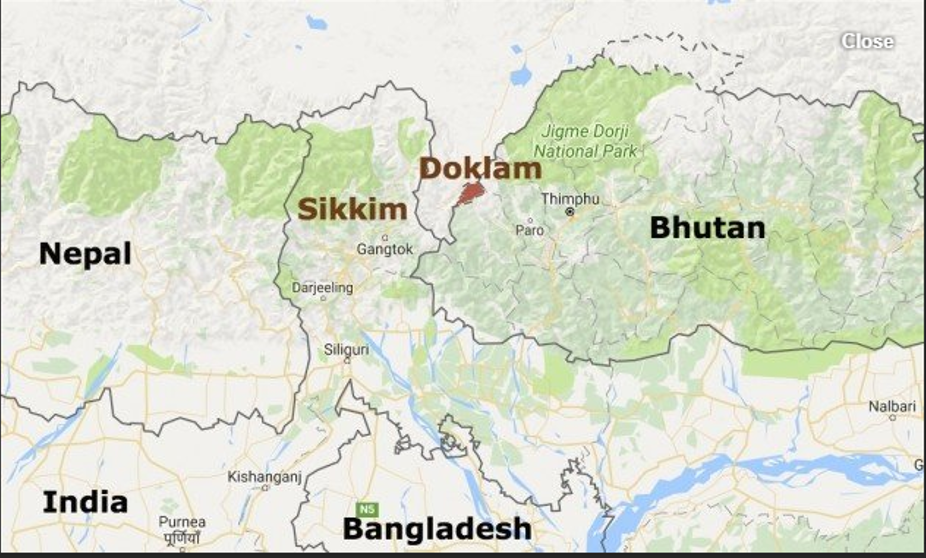
The standoff occurred began about two months ago when Chinese Soldiers marched into the Doklam Plateua, a territory of Bhutan, to build a road. The Chinese Communist Party (CCP) naturally finds no fault in this: in their eyes, they’re only building on Chinese Soil. However, Bhutan rightfully objects to the CCP’s ‘innocent’ road building and calls over the Indian Military for support. Bhutan is an interesting country; it cares more for the country’s gross national ‘happiness index’ than cultivating a strong military to ward of China. Although one might think that India and Bhutan are strong diplomatic friends, its not as simple as that: Bhutan’s foreign relations are still unofficially handled by New Delhi resulting in the Bhutanese being locked into regional conflicts with Pakistan and China which they don’t really prefer. A recent example is India and Bhutan boycotting the ‘One Belt, One Road’ summit: India’s reasons for the boycott was that the proposed road would pass the disputed region of Kashmir which both India and Pakistan claim and that the building of a road would see a large increase in Chinese warships in the Indian Ocean and land based troops to protect goods passing over the road. India’s reasons are understandable but India’s reasons are not the same as Bhutan’s needs; thus its a tad unfair on the Bhutanese. Nevertheless, the Doklam Plateau is a different matter, Bhutan actually needs Indian military support or else China will see it fair to annex more than just the Doklam Plateau.
The Indians think of their intervention as their righteous duty, a matter of pride and also of great strategic importance. They don’t want to bow to the likes of China and nor do they want Indo-Bhutanese relations to deteriorate. Answering to China’s invasion would allow India to show its capability in protecting its other disputed territories after its disastrous defeat in the Sino-Indian War of 1962 fought over Aksai Chin; its actions are mainly a warning to neighboring Pakistan. Below is map of the area:
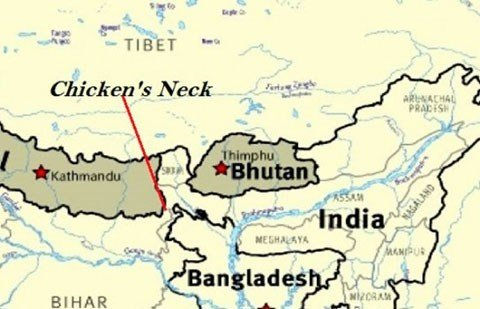
That ‘Chicken’s neck’ also known as the Silguri Corridor is the thread which connects the central Indian states to the Seven eastern sister states of Meghalaya, Assam, Manipur, Nagaland, Mizoram, Tripura and Arunachal Pradesh (another state China claims). With the Chinese creeping into Doklam, the corridor, already about a 10 hours journey from the border, becomes closer to them. The Silguri Corridor is strategically important to both countries: in the event of war, China could quickly capture the corridor and cut of the lifeblood of the Seven Sisters, staying true to the phrase ‘Divide and Conquer’ and making it easier for Chinese troops to launch an offensive into the states of Bihar, West Bengal and Jarkhand. This is the main reason for India’s avid deployment of troops to Bhutan, the fall of Doklam could lead to the fall of the Seven Sisters which could possibly ultimately lead to the fall of India.
However, war can be averted. No side wants conflict at this point of time, memories of the Sino-Indian War still run and besides, war would be a financial destroyer for both sides; China and India both have other important things to do rather than provoking war but the risk of it is not eliminated. If China and India do go to war, I would probably say that China would win. The Indian Military is not very centralized as the navy, air force and infantry usually work kind of autonomously; thus in the event of war, organisation for an offensive would probably take more time and thus a response might be too late. Furthermore, if the Chinese cut of the Chicken’s Neck, then they would be able to occupy the strategically important Indian state of Sikkim which is one of the only areas where India can launch a successful attack on the People’s Liberation Army (PLA). The PLA have also increased military response time to the border by building more roads within Tibet (which has contributed to more Han Chinese migrating to Tibet and thus dissolving ethnic uniqueness) thus increasing the chance of them repelling an Indian attack through Sikkim. In almost all ways, the PLA trumps the Indian Military whether it be in the amount of soldiers, warships, funding etc. Don’t forget! Pakistan absolutely hates India and would truly be eager to attack India if a war breaks out; I don’t think India would be able to survive a war on two fronts. Its a possibility that Russia could intervene but as seen by the joint military exercises carried out by China and Russia, intervention would either be unlikely or very minimal due to China becoming increasingly cosy with Russia. A war with India over Bhutanese territory will certainly puncture the image of China on the global stage; the Chinese taking land of a happy, peaceful Buddhist country will certainly spark some outrage. However, if conflict does occur, it will most likely be short as no side is keen to prolong it (thankfully).
I find China has been very unwise in its decision to provoke India. India is one of the largest consumers of Chinese goods and provoking it has lead to many boycotts of Chinese-made products; war or prolonged conflict could possibly effect the Chinese economy.
Furthermore, the ways in which the CCP are trying to undermine India are simply impertinent. On the 16th of August, state run news agency Xinhua published a racist video depicting the ‘seven sins of India’ in which a man dressed up in a fake turban and beard tries his best imitating an Indian Sikh and shamelessly tries to cover up China’s faults. This is simply audacious; Chinese state-run media has descended so low that they begin to mock Indian minorities for their own bigoted propaganda. One of the ‘seven sins’ the video explains is that India has sent a bulldozer to ‘ undisputed Chinese territory’; the woman states ‘driving a bulldozer straight into your house without knocking the door, what kind of neighbor would do that?’. Well as a matter of fact, the CCP regularly engages in forcibly relocating poor rural farmers of their land into cities to allow construction of various structures such as ‘ghost cities’ which will likely be never or minimally used; driving many farmers to suicide. The CCP also enjoys building military bases on disputed lands and often funds and hires assassins to kill journalists (whom only fault is being critical of the state) in their own streets and homes without knocking on their doors. What kind of person, let alone government would do such things? The video also tries to create a wedge between India and Bhutan and by criticizing India’s motive of ‘protecting Bhutan’. The woman states ‘ Bhutanese authorities have clearly told Chinese officials that Doklam is not Bhutan’s territory’. But Bhutan never gave up claims on Doklam as confirmed by the Bhutanese foreign minister Damcho Dorji. If I had time, I would criticize every ‘sin’ stated on the video but I want to voice just one more: China believes that Doklam is rightfully theirs due to what is cited in a 1890 Calcutta Convention during the era of the Qing Dynasty and British India. China is literally relying on a 127 year old treaty between two obsolete groups as an excuse to gain more territory and thinks the international committee is perfectly fine with such an outdated convention.
The best way to resolve this standoff is for negotiations to occur between China, Bhutan and India. Quarrels and threats cause nothing more than propagating hatred for each other’s country in the hearts of citizens and this hatred could eventually fuel war. Thus I urge both the Indians and the Chinese to stop making empty threats and try to figure out a solution instead of immaturely ridiculing each other. Hate would lead to more conflict; more conflict would lead to war and war would lead to the annihilation of millions of men, women and children.


Comments